Making a Small Flat Feel Bigger
Square footage is fixed. How a space feels is not — and most of the fixes cost nothing.
People assume a small flat feels small because it is small, and there's nothing to be done about it short of moving. That's only partly true. Two flats with identical floor area can feel completely different depending on how light moves through them, where the eye is allowed to travel, and how much visual noise is competing for attention at any given moment. Square footage sets a ceiling on how spacious a place can feel, but most flats are nowhere near that ceiling — they're being made to feel smaller than they are by habits that are easy to change.
Sightlines matter more than square metres
A room feels bigger when your eye can travel further before hitting an obstruction. This is why a cluttered small room feels tighter than an empty large one, and why moving a single piece of furniture out of a doorway's line of sight can change how a whole flat feels the moment you walk in.
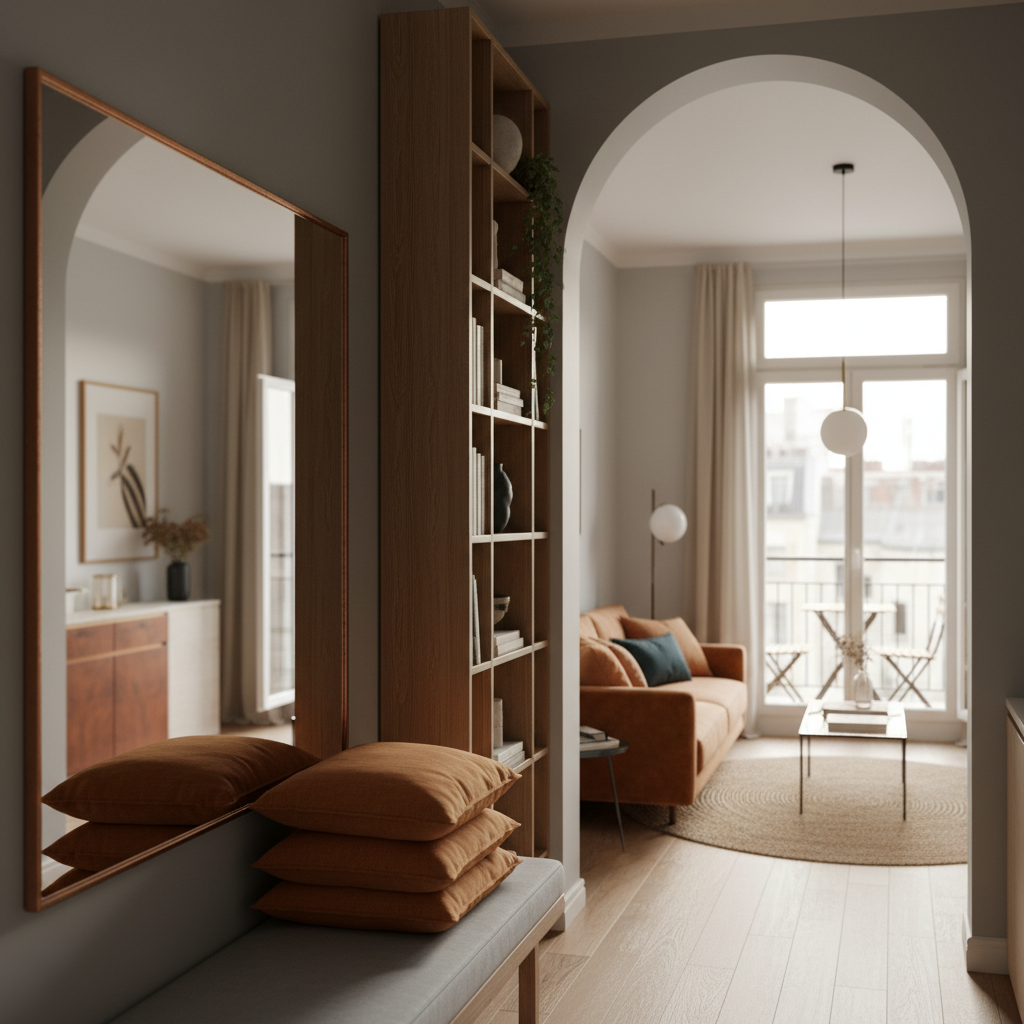
Stand at your front door and look straight ahead. Whatever your eye lands on first — a wardrobe, a stack of boxes, the back of a sofa — is setting the tone for the entire flat before you've taken two steps in. Clearing or opening up that first sightline is one of the highest-value changes you can make, and it costs nothing but rearranging.
A five-minute sightline audit
- Stand in each doorway and note the first large object your eye meets.
- If it's storage, see whether it can move against a side wall instead of facing the entry.
- Check whether curtains or blinds, even half-open, are cutting off a view to a window — pulling them fully back often adds more perceived space than any furniture move.
Light does more work than colour
Pale walls have a reputation for making rooms feel bigger, and there's something to that, but light itself matters more than the colour it's landing on. A room with one dim overhead bulb feels smaller than the same room lit by two or three lamps placed at different heights, because varied light sources make the edges of a room visible instead of letting them fade into shadow.
Layering light — a floor lamp in one corner, a table lamp in another, rather than relying on a single central fitting — pushes brightness out towards the walls, and a room whose corners you can actually see reads as larger than one where they disappear into gloom.
Mirrors, used deliberately
The mirror-makes-a-room-bigger advice is old but still under-used properly. A mirror only helps if it reflects something worth doubling — a window, a lamp, an open sightline — rather than a blank wall or the back of a cupboard. Placed opposite a window, a mirror can genuinely double the sense of light and depth in a room; placed at random, it just adds another object to look at.
Furniture scale, not furniture quantity
The instinct in a small flat is to buy small furniture, but oddly, a few pieces of appropriately generous furniture often read as more spacious than lots of tiny pieces. A single sofa that comfortably seats the number of people who actually use it, with clear floor around it, feels calmer than three mismatched small chairs squeezed into the same footprint. Furniture with visible legs, rather than pieces that sit flush to the floor, also helps — you can see floor continuing underneath, which the eye reads as extra space even if it isn't usable space.
| Instead of | Try | Why it helps |
|---|---|---|
| Several small low tables | One well-proportioned table | Fewer edges for the eye to process |
| Solid, boxy sofa base | Sofa with visible legs | Floor reads as continuous |
| Furniture pushed to face each wall | One or two pieces angled slightly, off the walls | Breaks the "boxed room" feeling |
Storage that hides, not storage that shouts
Open shelving looks appealing in photographs but in a genuinely small flat it often adds visual clutter, because every object on it is competing for attention. Closed storage — cupboards, boxes with lids, drawers — removes that noise even if the actual amount of stuff in the flat hasn't changed. The goal isn't to own less, although that helps too; it's to make sure what you own isn't visible all at once.
Vertical storage is underused in small flats. Wall space above eye level is almost always empty, and a shelf near the ceiling for items you use rarely — spare bedding, suitcases, seasonal things — frees up the low, visible storage for daily items, which in turn keeps surfaces clearer.
The surface rule
A useful habit: no flat surface — table, counter, shelf top — should be more than about two-thirds covered. Once a surface tips past that, it starts reading as cluttered even if every item on it is technically "in its place." Regularly clearing surfaces back below that threshold does more for a room's apparent size than most furniture decisions.
Rugs and flooring can visually extend a room
A rug that's too small for its space actually shrinks a room, because it creates a visible boundary well inside the room's real edges. A rug sized to reach close to the walls, or flooring that runs in one continuous material and colour across connected rooms, removes those internal boundaries and lets the eye read the space as one continuous area rather than several small, separate ones.
Curtains and windows: go bigger than the frame
Hanging curtains at the width and height of the actual window makes the window — and the wall around it — look smaller than it is. Mounting curtain rails wider than the window frame and closer to the ceiling than the top of the window creates the impression of a taller, wider window even though the glass itself hasn't changed. It's a small carpentry job, or sometimes just a different bracket position, for a noticeable shift in how a room reads.
Fewer, better-chosen decorative objects
In a small space, every decorative object has to earn its place twice over, because it's not just taking up shelf space, it's taking up visual attention in a room where attention is already limited. Choosing a handful of objects you actually like, rather than filling every available surface because it's there, keeps a small flat feeling deliberate rather than crowded. If you're weighing up new purchases for the flat, this is worth reading alongside our broader coverage on the lifestyle section about buying less but choosing better.
The takeaway
A small flat feels bigger when sightlines are kept clear from the doorway inward, when light is layered rather than centralised, when furniture is well-scaled rather than simply small, and when storage hides more than it displays. None of this changes the floor plan, and none of it requires spending much money — it just requires noticing what's actually shrinking the room, which is usually habit and clutter rather than the walls themselves.
Sound and texture affect perceived space too
Space isn't only visual. A room with hard, echoing surfaces — bare walls, tiled floors, no soft furnishing to absorb sound — can feel oddly cramped and stressful even if it's objectively roomy, because sound bounces around it in a way that reads as chaotic. Adding a rug, cushions, or even a few books on a shelf softens that acoustic bounce, and a calmer-sounding room tends to feel calmer and more spacious as a result. This is a genuinely under-discussed factor in how small flats feel, separate from anything to do with sightlines or light.
Multi-use furniture, chosen carefully
A folding table, a storage ottoman, or a sofa bed can let one small flat serve several functions without needing separate furniture for each. The caveat is that multi-use furniture only helps if it's used for its second purpose regularly — a sofa bed nobody ever folds down is just a slightly worse sofa taking up the same space as before. Before buying anything marketed as space-saving, it's worth being honest about whether you'll actually use the second function, or whether a simpler, single-purpose piece would serve you just as well for less money.
Test it before you commit
Before buying anything, live with a rearranged layout for a week. Move furniture with what you already own, clear one sightline, add one extra lamp, and notice whether the flat feels different before spending money on new pieces. Most of the improvement in how a small flat feels comes from arrangement and light, not purchases — which means you can test most of this article for free before deciding what, if anything, is worth buying.
When it's genuinely worth spending
If, after testing arrangement and light for free, the flat still feels cramped, the highest-value purchases tend to be a well-placed mirror, one or two proper lamps, and closed storage sized to what you actually own. These are modest costs compared with the alternative most people reach for first, which is moving to a larger and more expensive flat before exhausting the free options.
About the author
Idris Oyelaran covers consumer technology, privacy and applied science. He is happiest explaining a complicated system in ordinary language, and he tests every recommendation on his own devices before it appears in a story.