Cooking a Week of Meals Without Burnout
A calmer way to feed yourself all week, without turning your kitchen into a second job.
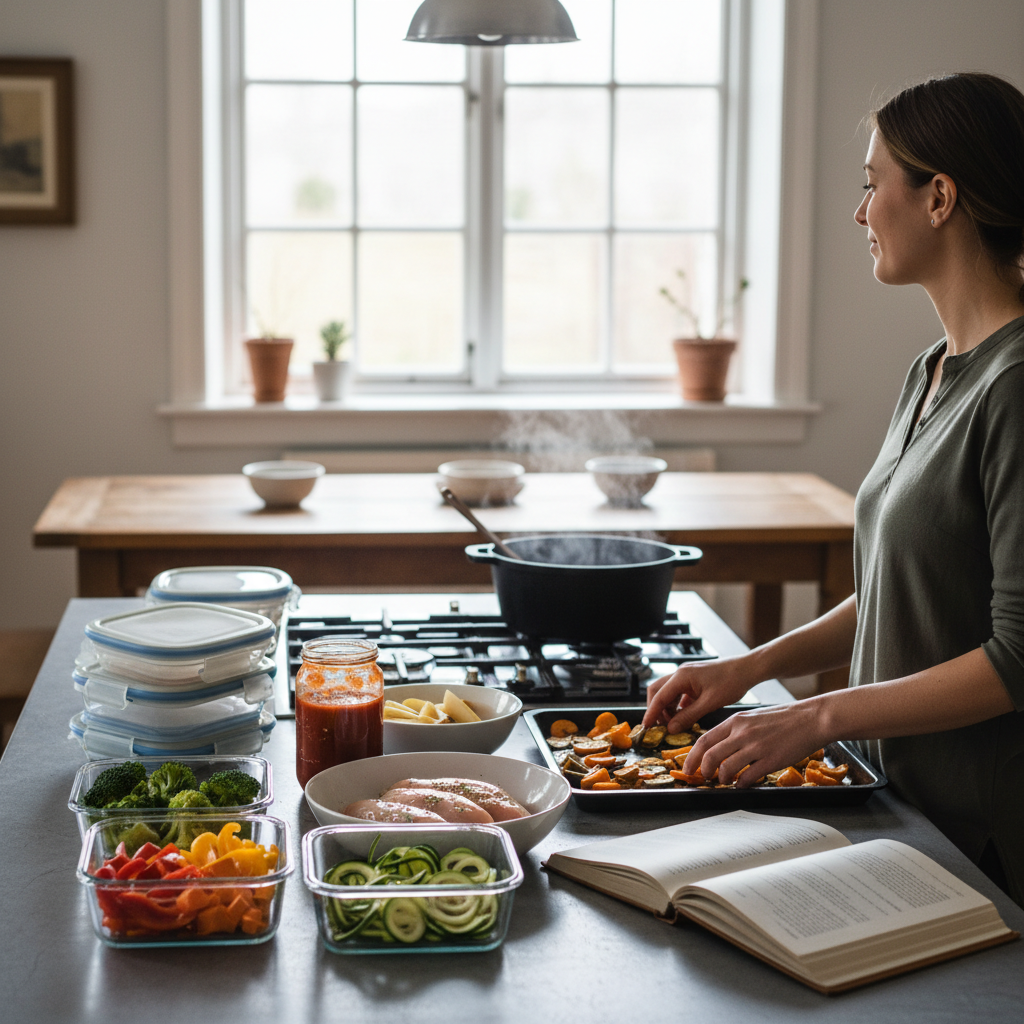
Most people who quit meal prep don't quit because it doesn't work. They quit because it works for about three weeks and then collapses under its own ambition — seven identical containers, a Sunday afternoon lost to chopping, and a fridge full of food nobody actually wants to eat by Thursday. The problem isn't the idea. It's the version of the idea that gets sold: rigid, uniform, and joyless. There's a calmer way to do this that still saves real time and money.
Why the all-or-nothing version fails
The standard meal-prep formula asks you to cook every meal for the week in one sitting, portion it into identical boxes, and eat the same thing five days running. That's a lot to ask of your Sunday, and it assumes your appetite and schedule stay fixed all week, which they rarely do. One late meeting, one dinner invitation, one day you simply don't want chicken and broccoli again, and the whole system feels like a failure rather than a flexible tool.
A more durable approach treats prep as stocking a kitchen with useful components, not assembling finished meals. You do less exact planning and more building blocks — things that combine in different ways depending on what you feel like eating on any given night.
Build a pantry of combinable parts, not a menu
Instead of deciding on Sunday exactly what Wednesday's dinner will be, spend your prep time on components that mix and match:
- A grain or starch: rice, couscous, roasted potatoes, or pasta, cooked in bulk.
- A protein: a tray of roasted chicken thighs, a pot of lentils, or hard-boiled eggs.
- A vegetable, roasted or quickly pickled, that keeps well in the fridge.
- A sauce or dressing with real flavour — this is the piece that stops everything tasting the same.
With those four things ready, dinner becomes assembly rather than cooking. Grain plus protein plus vegetable plus sauce, in whatever combination suits your mood, is dinner in under ten minutes. The sauce is doing more work than people realise: a sharp vinaigrette, a chilli-garlic oil, or a yoghurt and lemon dressing can make the same rice and chicken taste like three different meals across the week.
Why sauces matter more than recipes
If you only remember one thing from this article, make it this: variety in a week of eating comes far more from sauces and seasoning than from cooking different dishes from scratch each night. A jar of chimichurri, a spoon of harissa, or a simple soy-ginger dressing changes the entire character of a plate of rice and vegetables. Buying or making two or three sauces on prep day is a better use of your time than doubling the number of separate dishes you cook.
Time your effort to your actual week
Not every week deserves the same amount of prep. A week with three evenings out needs far less cooked food than a week you'll be home every night. Before you shop or cook, glance at your calendar and ask how many meals you genuinely need to have ready. Cooking for meals that never happen is where waste and burnout both start.
| Week type | What to prep | Time needed |
|---|---|---|
| Busy, home most nights | Full components: grain, protein, veg, two sauces | 60–90 minutes |
| Mixed, out two or three nights | One protein, one sauce, buy fresh veg as needed | 30–40 minutes |
| Very busy, home rarely | Emergency stock only: eggs, tinned beans, frozen veg | 10 minutes |
Cook in a way that doesn't eat your evening
Batch cooking gets a bad name partly because people schedule it badly, cramming everything into one long stretch after work when they're already tired. Two smaller sessions usually beat one marathon one. Twenty minutes on a Sunday to roast a tray of vegetables and boil a pot of grains, and another twenty on a Wednesday to refresh what's run low, keeps the task light enough that it never feels like a chore you're dreading.
It also helps to cook things that mostly look after themselves. A tray in the oven or a pot on the stove that needs stirring twice frees you to do something else — eat, read, deal with post — while it cooks. Meal prep shouldn't demand your full attention for an hour straight; it should run in the background of an ordinary evening.
Use the oven for more than one thing at once
If your oven is on anyway, it's rarely running at capacity. Roasting vegetables at 200°C for thirty minutes leaves plenty of room on the tray for a second vegetable, or a tray of chicken thighs on the shelf below. Getting two components out of a single oven session is one of the simplest ways to cut prep time without cutting variety.
Keep a running list of what actually gets eaten
Waste creeps in when you cook based on what you think you should eat rather than what you actually reach for. Keep a rough mental note — or a scrap of paper on the fridge — of which prepped items disappear fast and which linger until they're binned. If the roasted cauliflower never gets touched but the lentils vanish in two days, that's useful information for next week's shop. Meal prep improves fastest when it's adjusted against real evidence, not against what sounds virtuous.
Leave room for spontaneity
A week that's 100% planned leaves no space for the impulse dinner, the friend who invites you out, or the night you just want toast. Deliberately under-planning by one or two meals — buying slightly less than a full week's worth of components — takes the pressure off and stops good food going to waste because plans changed. Treat the gap as a feature, not a failure of foresight.
A simple rule of thumb
Plan for five dinners, not seven, even in a normal week. The other two will sort themselves out — leftovers, eating out, or something thrown together from what's left in the fridge. This small buffer is often the difference between a system that lasts and one that quietly falls apart by the second month.
Shopping that supports the system instead of fighting it
A shopping list built around components rather than named recipes is shorter and more forgiving. You're buying "a protein, a grain, two vegetables, ingredients for two sauces" rather than the specific ingredients for seven different recipes, several of which you'll abandon halfway through the week anyway. This also makes it far easier to shop seasonally and cheaply, since you're not locked into buying whatever a specific recipe demands regardless of price or freshness.
If you want a lasting habit rather than a fortnight of enthusiasm, treat this as one small adjustment among the daily choices covered across our lifestyle pages — a system you tweak slightly each week rather than a project you either nail perfectly or give up on.
The takeaway
Meal prep survives contact with a real week when it's built from flexible parts rather than fixed menus, when the effort is scaled to how busy the week actually is, and when there's deliberate slack for the meals you didn't plan. Sauces and seasoning, not extra dishes, are what stop the week tasting repetitive. Cook a little less than you think you need, pay attention to what actually gets eaten, and let the system flex around your real life instead of the other way round.
Freezer as a pressure valve
A freezer full of good building blocks is what stops a bad week turning into a takeaway week by default. Cooked grains, roasted vegetables, and portions of sauce all freeze well in small batches, so a night where cooking feels impossible can still start from something already made rather than from nothing at all. The trick is portioning before freezing — a single container of rice big enough for one dinner defrosts and reheats far more usefully than one giant block that takes an hour to separate.
Label what goes in with a date, even roughly. Food that's unlabelled tends to get forgotten at the back of the freezer until it's no longer appealing, which quietly undoes all the time you spent making it in the first place.
Where this system tends to break, and how to fix it
Two failure points come up again and again. The first is boredom — eating the same base ingredients too many times without changing the sauce or seasoning enough to notice a difference. The fix is treating your sauce rotation as seriously as your protein rotation, buying or making at least two distinct flavour directions each week. The second is over-preparing on the assumption that future-you will be more organised than present-you. The fix is simply preparing less than you think you need, since it's far easier to cook a quick top-up mid-week than to force yourself through a fridge full of food you're tired of looking at.
A note on cost
Buying components in bulk — a large bag of rice, a big tray of chicken thighs, vegetables in season — is almost always cheaper per portion than buying pre-made meals or ingredients for one dish at a time. The saving compounds over a month, and it's one of the more reliable ways to spend less on food without tracking every receipt.
One habit worth keeping
Write your loose plan on a sticky note on the fridge, not because you need to follow it exactly, but because seeing it stops you from opening the fridge at 7pm with no idea what to do with what's inside. A visible plan, even a rough one, removes the single biggest source of weekday cooking fatigue: decision-making at the point you're already hungry and tired.
About the author
Mara Devlin edits the publication and writes about the internet's infrastructure and incentives. She spent a decade as a technology reporter and editor before founding this masthead, and still does most of her reporting by reading documentation nobody else wants to read.