The Rise of the Podcast Interview
The long, loosely structured podcast conversation has become one of the dominant formats for public discussion, reshaping how public figures are questioned and how audiences expect to hear from them.
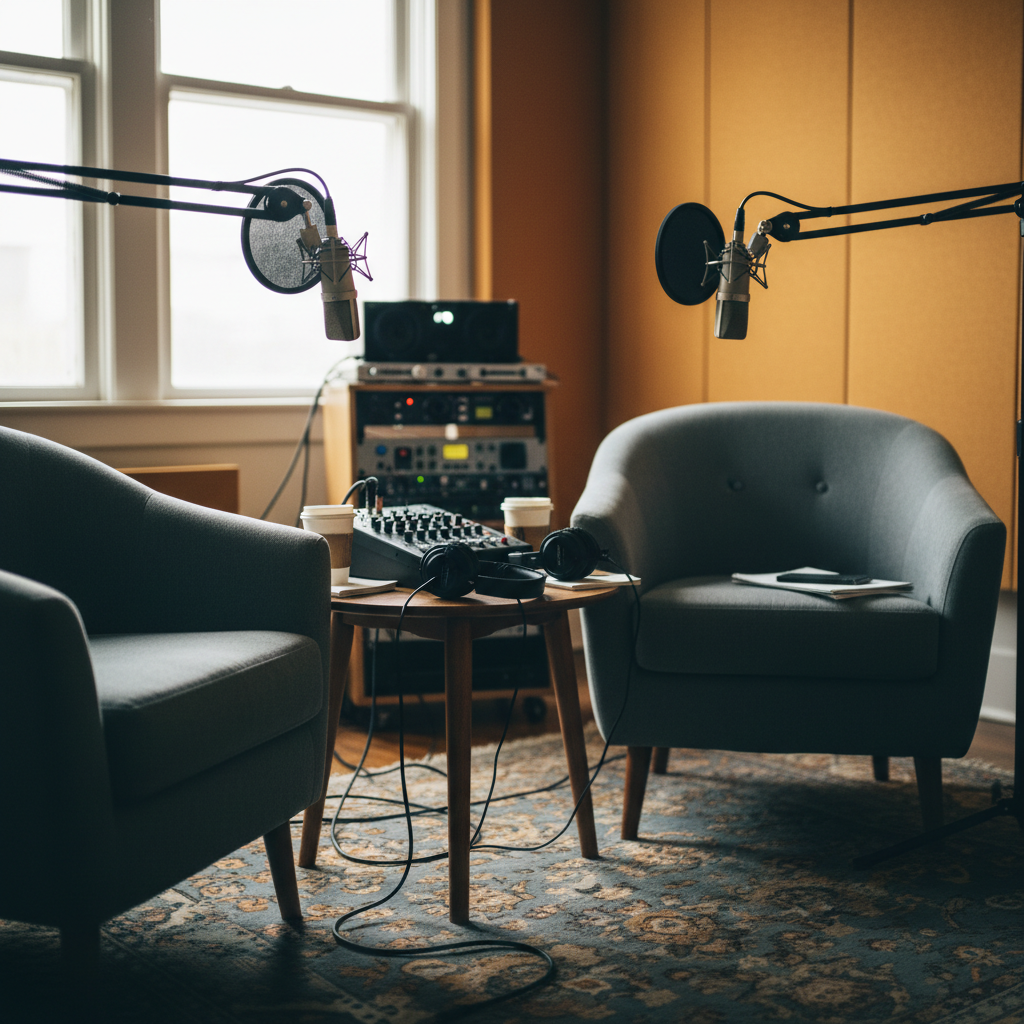
A senior politician, a scientist promoting a new book, or a musician between albums now has a choice that barely existed fifteen years ago: sit for a tightly produced six-minute television segment, or spend two or three unhurried hours on a podcast, talking through ideas at whatever pace the conversation naturally takes. Increasingly, many choose the latter, and the reasons behind that choice say a great deal about what has changed in how the public consumes long-form conversation.
What the format actually offers
The core appeal of the podcast interview is time. Traditional broadcast interviews are built around strict segment lengths, driven by advertising breaks and rigid scheduling, which forces interviewers to prioritise punchy, quotable exchanges over sustained exploration of a single idea. A podcast interview, freed from most of those constraints, can follow a tangent for ten minutes if it turns out to be interesting, or spend the first half hour just establishing context that a broadcast interview would have had to cut entirely.
This changes the kind of answer a guest can give. Complex, hedged or evolving positions, the kind that are hard to compress into a soundbite, become possible to actually explain rather than simplify or avoid. For guests with technical or specialist subject matter, this can be a genuine improvement in how well the public understands their work. For guests managing a public image, it is also an opportunity to shape a narrative at length, with far less adversarial pushback than a traditional current affairs interview might provide.
Control shifted toward the guest
One of the more significant structural shifts is who controls the terms of the conversation. Traditional interview formats, particularly in news and current affairs broadcasting, are built on an adversarial premise: the interviewer represents the public's right to ask hard questions, and the format assumes some tension between interviewer and subject is healthy. Many popular podcast interview formats operate on a different premise, closer to an extended, friendly conversation than an interrogation, and hosts of the most successful shows in this space have generally built their audience specifically by being less confrontational than mainstream broadcast journalists.
This shift has real consequences. Guests, particularly public figures with something to promote or defend, increasingly gravitate toward interview formats where they know the tone will be conversational rather than adversarial, and where a favourable, extended airing of their views is more likely than a hostile line of questioning. Critics of this trend argue it has weakened the accountability function that traditional interviews were partly designed to serve, allowing public figures to reach very large audiences while facing considerably less rigorous scrutiny than they would in a traditional press setting.
Audio intimacy plays a role too
There is also something format-specific happening with audio itself. Listening to a long conversation, often through headphones, directly into the ear, while doing something else, driving, walking, doing chores, creates a different relationship with the speaker than watching a formal television segment. Many listeners describe a sense of familiarity with podcast hosts and frequent guests that resembles overhearing a conversation between people they know, rather than watching a formal, distanced media presentation. That sense of intimacy builds trust and engagement, but it can also lower a listener's guard against claims that might be scrutinised more carefully in a different format.
How the format changed who gets platformed
Podcasting's low barrier to entry, requiring little more than recording equipment and a distribution platform, has allowed interview shows to be built entirely outside traditional media institutions, hosted by people with no journalism background at all. Some of the most widely heard interview podcasts today are run by former athletes, comedians, technologists or subject-matter enthusiasts rather than trained journalists. This has broadened who gets to conduct high-profile interviews considerably, but it has also removed much of the institutional infrastructure, editorial oversight, fact-checking, correction policies, that traditional outlets built up over decades specifically to manage the risks of platforming influential voices.
How podcast interviews commonly differ from broadcast interviews
- Length: often ninety minutes to three hours versus five to twenty minutes
- Structure: loosely conversational versus tightly segmented
- Editorial oversight: frequently minimal versus formal editorial review
- Tone: often collegial versus sometimes adversarial
- Distribution: on-demand, algorithm-driven versus scheduled broadcast slots
The economics behind the shift
Podcast interview shows have also become genuinely lucrative, which has accelerated their growth independent of any purely editorial merit. Advertising within podcasts, often delivered directly by the host in a personal, endorsement style rather than as a separate produced advert, has proven unusually effective at converting listener attention into sales, partly because of the same intimacy and trust dynamics discussed above. Sponsorship deals, along with direct licensing agreements with streaming platforms, have made top podcast interview shows commercially comparable to, and in some cases more valuable than, traditional television programming with far larger production budgets.
This economic reality has pulled experienced broadcast journalists and producers into podcasting as well, not just amateur hosts, producing a middle tier of shows that combine some of the editorial rigor of traditional journalism with the format flexibility of podcasting. The result is a genuinely varied landscape, ranging from rigorously prepared long-form journalism to loosely structured, unchallenged promotional conversations, all filed under the same broad "podcast interview" label.
What gets lost in the long format
It would be a mistake to treat length as an automatic virtue. A three-hour conversation is not inherently more informative than a well-prepared ten-minute interview; it is simply differently structured. Long-form conversations can drift, repeat themselves, or allow a guest to talk around a difficult question at length rather than being pressed to answer it directly, something a shorter, more tightly produced format makes harder to get away with. The perception that a longer interview automatically means a more honest or thorough one is itself a kind of format bias, and listeners are often better served by evaluating whether difficult questions were actually asked and answered, rather than simply how much time the conversation took.
Audiences have adapted their listening habits accordingly
Listener behaviour around podcast interviews has developed its own norms. Many listeners do not consume an episode start to finish in one sitting, instead treating it as background audio across a day, skipping sections, or listening at increased playback speed. Podcast apps commonly offer variable speed playback as a default feature, and a meaningful proportion of listening happens at 1.5x speed or faster, changing the pacing and tone of the delivery from what the host and guest actually recorded. This has, in turn, influenced how some hosts structure their shows, favouring clear verbal signposting and chapter markers so listeners can navigate a long episode non-linearly rather than requiring full sequential listening.
A format still finding its norms
Because podcast interviewing grew so quickly and largely outside traditional media institutions, it has not yet developed a widely agreed set of professional norms comparable to those that govern print or broadcast journalism, around disclosure, fact-checking, correction policies or conflicts of interest. Some of the most established shows have adopted their own internal standards, but there is no industry-wide equivalent to the editorial guidelines a national newspaper or broadcaster typically operates under. This is likely to change as the format matures and as scrutiny of high-profile podcast interviews, particularly ones involving political or scientific claims, continues to increase.
The role of clips in a full-length episode's afterlife
A large share of the audience for any given podcast interview never listens to the full episode at all. Short video clips, pulled from a much longer conversation and distributed separately on social platforms, have become the primary way many people encounter podcast interview content, often without ever visiting the podcast itself. This creates a strange dynamic where a two-hour conversation is judged and shared almost entirely on the basis of a ninety-second excerpt chosen, sometimes by the show's own production team, specifically because it is provocative or shareable rather than because it best represents the conversation as a whole. Guests and hosts alike are increasingly aware of this dynamic while recording, which has begun to subtly shape how answers are phrased, with an eye toward what might travel well as a standalone clip.
International and non-English language podcast interviewing has grown alongside it
While much of the commercial attention around podcast interviewing has focused on English-language shows, the format has grown rapidly in numerous other language markets as well, often adapting the same core structural features, extended length, conversational tone, minimal editorial oversight, to different cultural and political contexts. In some countries, podcast interviews have become an important outlet for voices that face more restriction in traditional broadcast media, offering a lower-barrier route to a large audience. This has made the format politically significant well beyond the media markets most commonly discussed in coverage of podcasting's rise.
Advertisers have adapted to this clip-driven reality as well, increasingly negotiating for guaranteed clip promotion alongside traditional in-episode reads, recognising that a sponsor mention buried in hour two of a long conversation reaches a fraction of the audience a well-placed clip can reach across multiple platforms within days of release.
Where this leaves the interview as a form
The podcast interview did not replace the traditional broadcast interview so much as split the format into different tools suited to different purposes. Short, adversarial interviews still serve a genuine accountability function that long, conversational formats generally do not attempt to replicate. Long-form podcast conversations serve a different, complementary function: allowing complex ideas room to breathe and allowing audiences to hear public figures at a length and pace that television scheduling was never built to accommodate. Understanding which format is being used, and what its structural incentives actually reward, is probably the most useful thing a listener can bring to either one. More on media formats and how they shape public discussion can be found in culture.
About the author
Helena Vos writes about media, culture and how small businesses actually operate. She previously worked in independent publishing, which is where she learned to distrust round numbers and unsourced statistics.