How Public Libraries Reinvented Their Purpose
Libraries have quietly become the last free public spaces doing everything from job coaching to climate refuge, and the shift says a lot about what a book-lending institution can become.
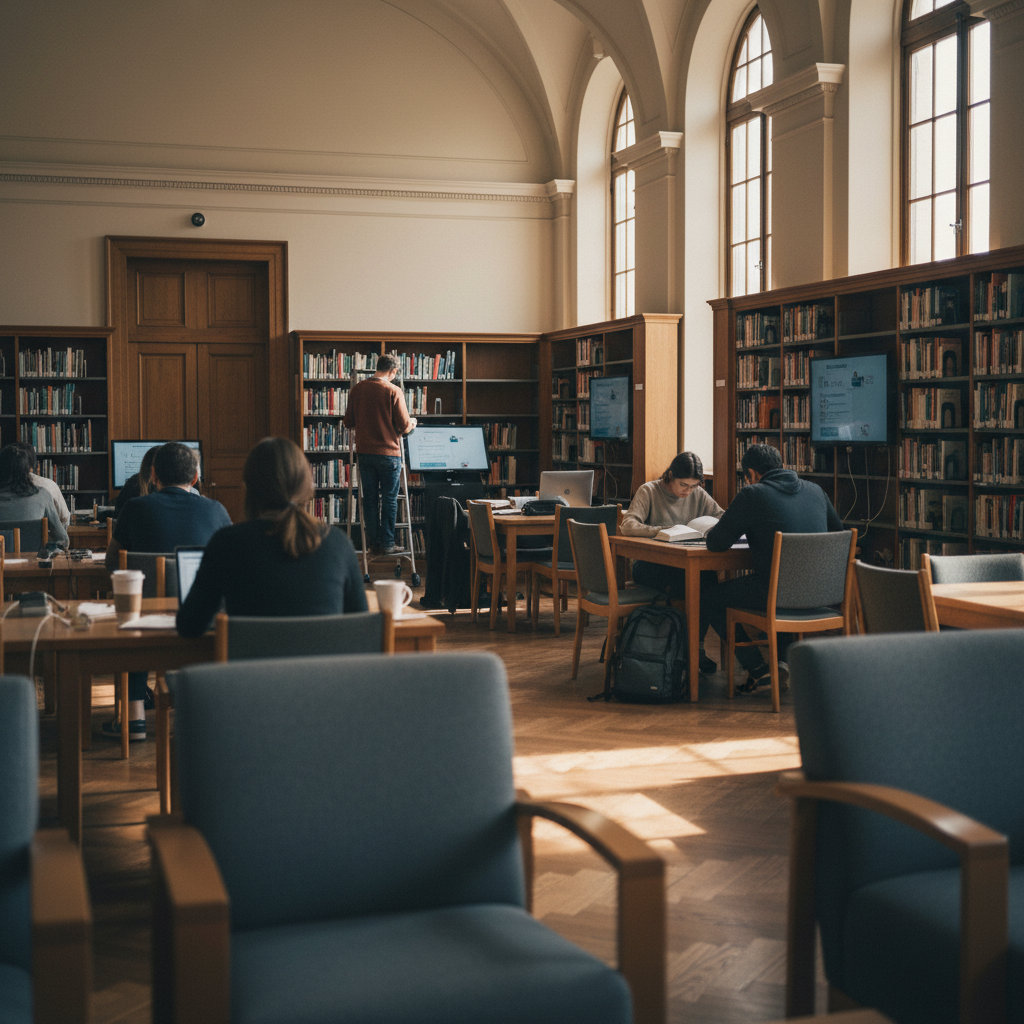
Walk into a mid-sized public library on a Tuesday afternoon and you will likely see fewer people browsing shelves than you expect and more people doing almost everything else. A teenager is using a library laptop to fill out a college application. A retiree is getting help resetting a password for a government benefits portal. A parent is at a toddler storytime that doubles as the only regularly scheduled social contact of their week. Someone is charging a phone in a corner because the library is warm, dry and free to sit in for as long as they like. None of this is a departure from what a library does. It is what a library has quietly become.
From book warehouse to civic utility
The nineteenth-century public library was built on a fairly narrow premise: that access to printed knowledge should not depend on wealth, and that a shared collection, properly catalogued, could raise the general level of a community's education. That premise still holds, but the practical work of libraries has expanded well beyond it, largely because the gaps in public life around them have widened.
As government services moved online, libraries became the default place where people without home internet or without confidence in digital forms went to get help. As mental health and social services thinned out in many places, library staff became an informal first point of contact for people in crisis, sometimes trained in things no early librarian could have imagined, such as how to respond to an overdose or how to de-escalate a confrontation. As childcare and early years support became harder to access, storytime and free after-school programming filled part of that hole. None of this was planned centrally. It accumulated, branch by branch, in response to whoever walked through the door.
The building itself became the point
One under-discussed part of this shift is architectural. A library does not require a purchase to justify a visit. There is no menu, no ticket, no obligation to buy something to sit down. In a retail environment increasingly hostile to lingering without spending, that makes the library one of the few remaining indoor public spaces where a person can exist for hours without transaction. Urban planners sometimes describe places like this as part of the "third place" idea, somewhere that is neither home nor work but still holds a community together.
Library design has followed this logic. New and renovated branches increasingly include:
- Bookable meeting rooms for community groups, small businesses and tutoring
- Quiet study areas separated from active children's zones
- Maker spaces with printing, sewing or basic tool equipment
- Outdoor seating and reading gardens where climate allows
- Dedicated space for social workers or benefits advisors on set days
None of these features has much to do with lending books, but all of them extend the founding idea of the library: shared infrastructure that belongs to everyone equally, regardless of what they can afford.
Collections still matter, just differently
It would be wrong to read this as libraries abandoning the book. Circulation of physical books remains the backbone of most branches' identity, and demand for popular fiction, especially in genres like romance and fantasy, has stayed remarkably resilient even as digital reading options multiplied. What has changed is the range of what a "collection" includes. Many library systems now lend tools, musical instruments, seed packets for home gardening, mobile hotspots, telescopes and even museum passes. The logic is consistent: if an item is expensive to own but only occasionally needed, a shared public collection makes more sense than thousands of private purchases.
This has also reshaped what librarians do day to day. Cataloguing and reference work remain core skills, but many librarians now spend significant time on programming design, digital literacy instruction and partnership building with local charities and schools, closer to a community organiser's role than a stereotype of a quiet shelver would suggest.
The library as climate shelter
A less comfortable but increasingly important role has emerged in places experiencing extreme heat, wildfire smoke or prolonged power outages. Public libraries, along with a small number of other civic buildings, have become de facto cooling and clean-air centres during heatwaves and smoke events, because they are air-conditioned, filtered, open long hours and require no payment to enter. Library systems in regions that regularly face extreme summer heat have begun formally designating certain branches as cooling centres, extending hours during heat emergencies and coordinating with emergency management agencies rather than treating the role as incidental.
This use case exposes a tension. Libraries were not built or funded with climate refuge in mind, and asking them to absorb this function without additional resources puts pressure on staff who are already managing a widened set of responsibilities. It is one of several ways the library has been asked to do more without a proportional increase in support, a pattern common to public institutions that quietly prove useful.
Digital access without digital exclusion
Libraries have also taken on a specific and unglamorous job: keeping people connected to a digital world that assumes everyone already is. This includes basic device literacy classes, help navigating tax and benefits websites, and simply offering a place with reliable internet and a computer for people who do not have either at home. It is easy to underestimate how much of modern life, from job applications to prescription renewals to school registration, now assumes broadband access and a certain baseline comfort with forms and logins. Libraries have become one of the few institutions actively working to close that gap rather than simply assuming it does not exist.
What a modern branch typically balances
| Traditional role | Expanded role |
|---|---|
| Lending books and periodicals | Lending tools, instruments and technology |
| Reference and research help | Digital literacy and benefits navigation support |
| Quiet reading space | Community meeting rooms and maker spaces |
| Children's storytime | Structured after-school and holiday programming |
| Shelter from weather incidentally | Designated cooling or clean-air centre during emergencies |
The funding problem underneath all of this
None of this expanded role comes free, and library funding in most places has not grown to match it. Public libraries are typically funded through a mix of local taxation, state or national grants and, increasingly, private philanthropy or foundation support, which can be unpredictable and tied to specific projects rather than ongoing operating costs. When budgets tighten, the tension between "core" services like collections and "expanded" services like social support becomes a real policy argument, not an abstract one, because branch hours, staffing levels and even which locations stay open are all on the table.
This is part of why library advocacy has shifted tone over the past decade. Arguments for library funding increasingly emphasise measurable community outcomes, such as job-seeker support or early literacy gains, rather than a general appeal to the value of reading. It is a pragmatic shift, and it reflects how libraries themselves have had to justify their expanded mandate to the people who fund them.
What this expansion says about public space generally
The library's transformation is worth paying attention to beyond the library itself, because it illustrates something about the erosion of unconditional public space more broadly. As commercial spaces increasingly gate access behind purchase, and as many traditional civic institutions have shrunk or closed, the library has absorbed demand almost by default, not because it was designed to be the last no-cost indoor space in a given town, but because it was one of the few institutions flexible enough to become that by necessity.
Whether this is sustainable is a genuinely open question. Library staff are not trained social workers, emergency responders or IT help desks, even as they are increasingly asked to act as all three. The institution's strength, its openness to anyone regardless of need or ability to pay, is also what makes it absorb pressures that other, better-resourced systems have failed to handle. A library branch is, in a sense, a pressure valve for a wider set of civic gaps.
Staff training has had to expand alongside the mission
One consequence of this broadened role rarely discussed outside the profession itself is what it demands of library staff training. A library assistant hired twenty years ago to help patrons find reference material now might also need basic training in recognising a mental health crisis, administering an overdose-reversal medication in some jurisdictions, or calmly de-escalating a dispute between patrons in a crowded reading room. Many library systems have responded by bringing in outside trainers from social work and emergency response backgrounds, and some now employ social workers directly on staff, embedded within branches rather than visiting occasionally. This represents a genuine professional shift, not a minor addition to a job description, and it has prompted ongoing debate within library associations about whether frontline staff should be expected to take on quasi-social-work duties without the pay, protections or training that a dedicated social worker would normally receive.
Rural and small-town libraries carry a different weight
The expanded civic role of libraries looks somewhat different outside major cities. In small towns and rural areas, where other public services have often thinned out more severely than in urban centres, a single branch library can be the only reliably staffed public building offering free internet, printing, meeting space and children's programming within a wide radius. This concentration of function makes rural library funding decisions unusually consequential: closing or reducing hours at a single branch in a sparsely populated area can eliminate a community's only remaining free indoor public space entirely, rather than simply reducing the number of options available, as a similar cut might do in a city with several nearby alternatives.
A quietly radical proposition
What makes the modern public library worth writing about is not any single new service but the cumulative logic behind all of them. The founding idea, that access to knowledge and space should not depend on money, has simply been applied to more and more of what people actually need on a given day: warmth, wifi, company, quiet, help with a form, a place for a child to hear a story. None of that required a rebranding exercise. It required an institution willing to keep asking who walked through the door and what they needed, and to keep saying yes.
The result is one of the more understated success stories in public culture: an institution built around lending books that has, without much fanfare, become one of the most reliable pieces of social infrastructure many communities have left.
About the author
Idris Oyelaran covers consumer technology, privacy and applied science. He is happiest explaining a complicated system in ordinary language, and he tests every recommendation on his own devices before it appears in a story.