Why the sky changes colour through the day
From pale blue at noon to deep orange at dusk, the sky is telling a story about light and distance.
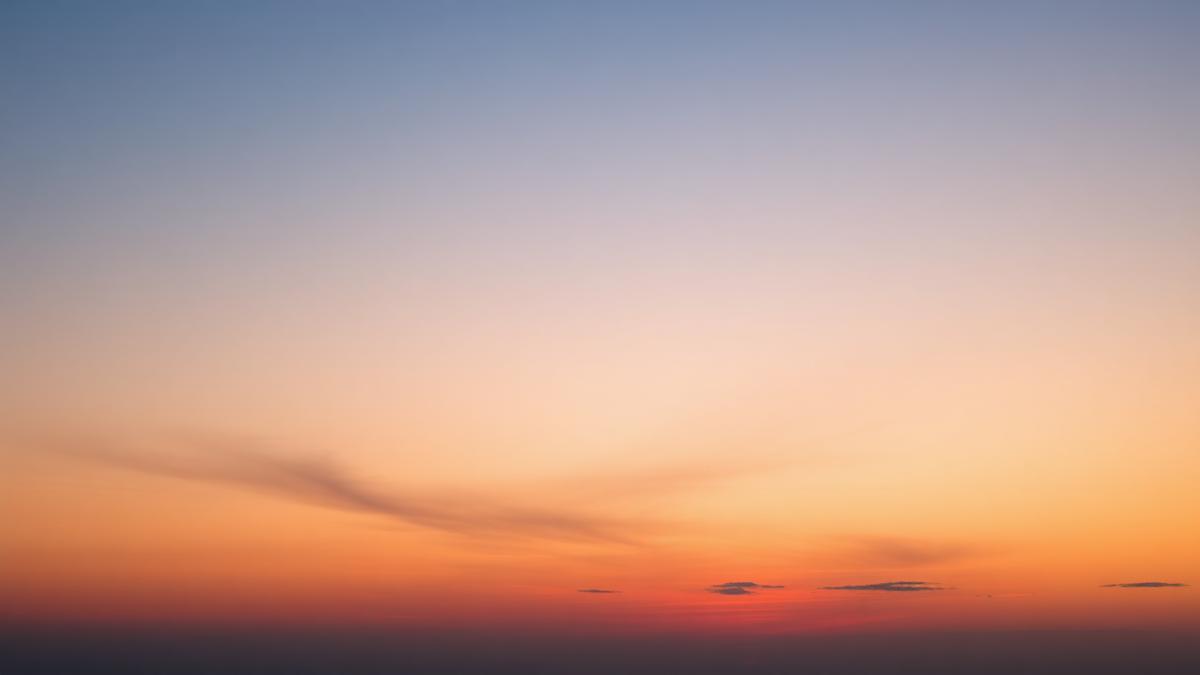
Sunlight looks white, or close to it, but it is really a mixture of every colour the eye can see, each travelling as a wave of a slightly different length. What happens to that mixture on its way through the atmosphere determines what colour the sky appears to be at any given moment, and the story changes depending on how much sky the light has to pass through.
Light meets the atmosphere
The atmosphere is full of gas molecules far smaller than the wavelength of visible light. When sunlight collides with these molecules, it scatters in many directions, a process known as Rayleigh scattering. Crucially, this scattering does not treat all colours equally. Shorter wavelengths, toward the blue end of the spectrum, scatter far more readily than longer wavelengths toward the red end. Blue light gets knocked around the sky in every direction, while red light tends to travel through in a straighter line.
This is the entire reason the sky is blue rather than white or colourless. Looking up on a clear day, the light reaching your eyes from any patch of empty sky is mostly blue light that has been scattered toward you from sunlight passing overhead, rather than light coming directly from the sun itself.
Why not violet, if it scatters even more
Violet light actually scatters more than blue light, since it has an even shorter wavelength. The sky is not violet for a couple of reasons: sunlight itself contains less violet light than blue to begin with, and the human eye is considerably less sensitive to violet than it is to blue. The combination of these two effects means blue dominates what we perceive, even though violet is being scattered just as enthusiastically.
What happens near the horizon
At sunrise and sunset, the sun sits low, and its light has to travel through a much greater thickness of atmosphere to reach an observer's eyes than it does at midday. Over that longer path, most of the blue light is scattered away before it ever gets close, spread out across the sky far from where you are looking. What remains and reaches your eyes directly is light weighted toward orange and red, the wavelengths least affected by scattering.
This is why sunsets and sunrises turn warm colours while midday skies stay cool blue: the same physical process is happening, just over a dramatically longer stretch of air.
What changes the display from one evening to the next
- Dust and pollution particles, which scatter light differently from gas molecules and can deepen or mute sunset colours.
- Humidity and cloud droplets, which add their own scattering and can produce pink and purple hues.
- Altitude, since thinner air at higher elevations scatters less light overall, often producing a darker blue sky.
- The angle of the sun relative to the horizon, which changes with season and latitude.
A quick comparison
| Time of day | Path length through atmosphere | Dominant colour reaching the eye |
|---|---|---|
| Midday | Short | Blue, from scattered light across the sky |
| Sunrise or sunset | Long | Orange and red, from direct light with blue scattered away |
| Overcast conditions | Variable | Grey and white, from light scattered many times by water droplets |
Why clouds and grey skies are different
Clouds are made of water droplets rather than gas molecules, and these droplets are large enough that they scatter all wavelengths of light roughly equally, rather than favouring blue. This is why clouds usually appear white or grey rather than any single colour — the light bouncing around inside them has largely lost its wavelength bias by the time it reaches the ground.
Other planets, other skies
The same physics applies wherever there is an atmosphere, but the result depends on what that atmosphere is made of. A thicker atmosphere, different gases, or heavier dust content all change which wavelengths scatter most, which is part of why skies on other planets have been observed and modelled to look strikingly different from Earth's own. The underlying principle, scattering favouring certain wavelengths over others, stays the same even as the visible outcome changes.
A process, not a fixed colour
It can be tempting to think of the sky as blue with occasional, unexplained exceptions at sunrise and sunset. It is more accurate to think of the sky as a single ongoing physical process — sunlight scattering through gas — that produces different visible results depending on the length of the path the light travels and the particles it happens to pass along the way. For more explanations of everyday physical phenomena, see our science coverage.
Sources
About the author
Idris Oyelaran covers consumer technology, privacy and applied science. He is happiest explaining a complicated system in ordinary language, and he tests every recommendation on his own devices before it appears in a story.