What Causes Tides
The oceans rise and fall twice a day because of a tug of war between the Moon, the Sun and the spinning Earth itself.
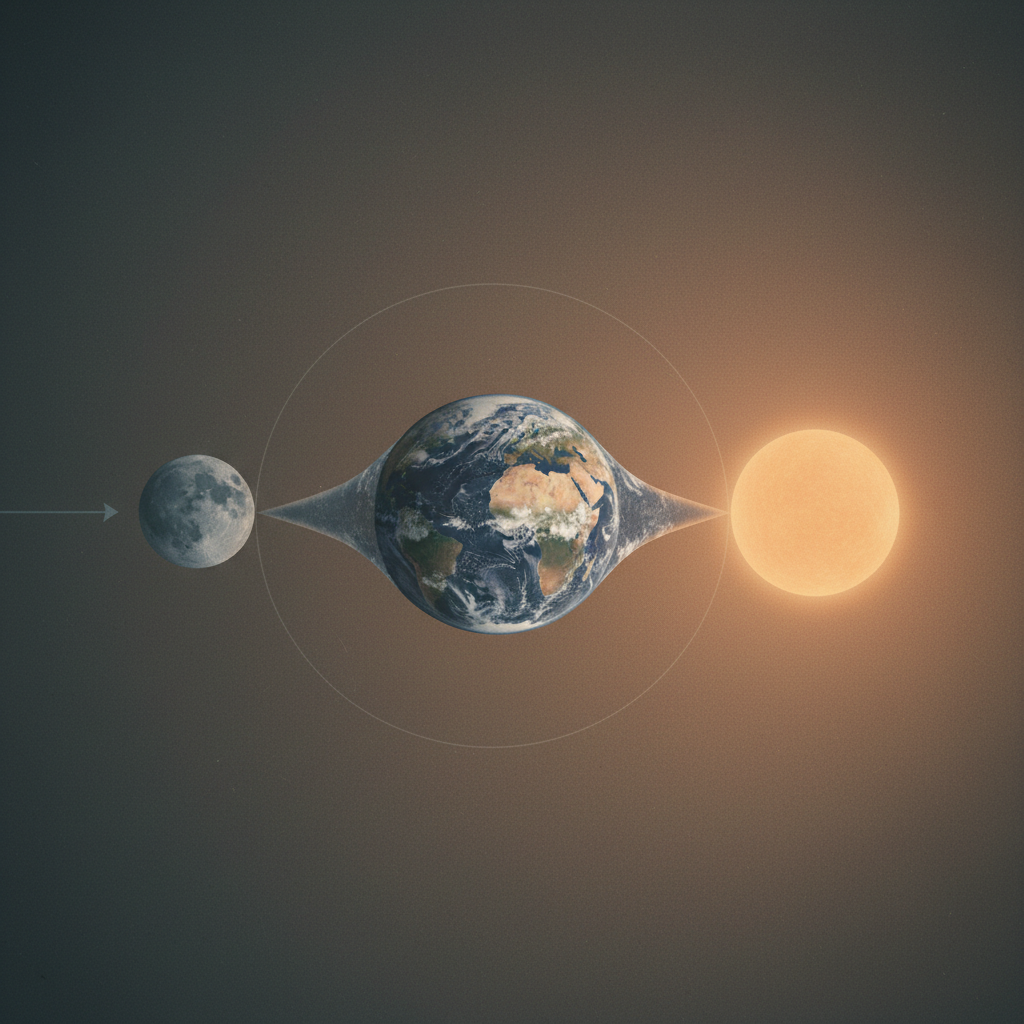
Stand on a beach at dawn and the water might lap gently at your ankles. Return twelve hours later and the same spot could be dry sand, or deep underwater, depending on where you are. This daily rhythm, ancient and reliable enough that sailors have used it for navigation for thousands of years, comes down to gravity acting on an enormous, mobile layer of water draped over a spinning planet.
Gravity's simple part
Every object with mass pulls on every other object with mass, a relationship described by gravitation. The Moon, despite being much smaller than Earth, is close enough that its gravitational pull noticeably tugs on Earth's oceans, stretching the water slightly toward it. This produces a bulge of ocean on the side of Earth facing the Moon.
If this were the whole story, there would be exactly one high tide a day as Earth rotated beneath that single bulge. But coastlines around the world experience roughly two high tides and two low tides every 24 hours and 50 minutes, which means something else is going on.
The second bulge: a trick of inertia
The missing piece is that the Earth and Moon do not simply have the Moon orbiting a stationary Earth. Both bodies orbit their shared centre of mass, a point called the barycentre, which lies inside the Earth but off-centre from its core. As Earth swings around this point, everything on the far side from the Moon experiences slightly less gravitational pull toward the Moon than the planet's centre does, and this difference causes the water on the far side to be left behind relative to the solid Earth, bulging outward in the opposite direction.
The result is two bulges, one on the side nearest the Moon caused by direct gravitational pull, and one on the far side caused by inertia lagging behind. As Earth rotates through both bulges once a day, most coastlines experience two high tides and two low tides.
The Sun's supporting role
The Sun is vastly more massive than the Moon, but it is also far more distant, and tidal force weakens rapidly with distance in a way that gravitational attraction alone does not. The net effect is that the Sun's tidal influence on Earth's oceans is a little under half the Moon's, still significant, but secondary.
When the Sun, Earth and Moon line up, at new moon and full moon, their combined pull produces unusually high high tides and unusually low low tides, known as spring tides. This has nothing to do with the season; the name comes from the water "springing up." When the Sun and Moon are at right angles to each other, around the first and last quarter moon, their pulls partly cancel out, producing more modest neap tides.
A quick reference
| Moon phase | Sun-Moon alignment | Tide type |
|---|---|---|
| New moon | Sun and Moon aligned | Spring tide (large range) |
| First quarter | 90 degrees apart | Neap tide (small range) |
| Full moon | Sun and Moon aligned | Spring tide (large range) |
| Last quarter | 90 degrees apart | Neap tide (small range) |
Why tidal range varies so much by location
If tides were purely a matter of two smooth bulges moving around a featureless ocean, every coastline would experience similar tidal ranges. In reality, the range varies enormously, from barely noticeable in some enclosed seas to more than fifteen metres in the Bay of Fundy in Canada. This is because ocean basins are not uniform bathtubs; they have their own shapes, depths and resonant properties.
As the tidal bulge moves through an ocean basin, it behaves partly like a wave sloshing in a container of a particular size and shape. Some basins amplify this sloshing through resonance, in the same way pushing a swing at just the right rhythm builds up a bigger motion, producing dramatically large tidal ranges. Narrow, funnel-shaped bays can further concentrate incoming tidal energy, squeezing the same volume of water into a shrinking channel and forcing the water level to rise more steeply.
Local geography matters too
- Funnel-shaped coastlines and bays amplify tidal range by concentrating incoming water.
- Shallow continental shelves can slow and pile up tidal waves, increasing their height near shore.
- Enclosed or nearly enclosed seas, such as the Mediterranean, often see much smaller tides because there is limited room for water to move in and out.
- Underwater ridges and straits can either block or channel tidal flow, creating strong tidal currents in specific locations.
Tides are not just about the coast
Although tides are most visible where ocean meets land, the same gravitational stretching acts on the solid Earth itself, causing the ground to rise and fall by a small amount, typically a few tens of centimetres, in a phenomenon called the Earth tide. The atmosphere experiences a subtler version too. Neither is noticeable to human senses, but both are measurable with sensitive instruments and are accounted for in fields such as precision surveying and satellite positioning.
Why the tidal day is slightly longer than 24 hours
A subtlety often missed is that high tide does not occur at exactly the same clock time every day. This is because the Moon itself is also moving, orbiting Earth roughly once every 27.3 days in the same direction Earth spins. By the time Earth has completed one full rotation, the Moon has shifted slightly further along its orbit, so Earth needs to rotate a bit further to catch up to the same position relative to the Moon. This adds about 50 minutes to the tidal cycle, which is why tide times shift a little later each day, a pattern coastal communities and fishers have tracked for centuries.
A planetary rhythm worth appreciating
Tides are one of the few large-scale phenomena where the effects of orbital mechanics become directly, physically visible in daily life, no telescope required, just a beach and some patience. The interplay of the Moon's pull, the Sun's contribution, and the peculiar shapes of ocean basins turns a simple gravitational relationship into one of the most locally varied phenomena on the planet. For more on the mechanics shaping the natural world, visit our science section.
About the author
Helena Vos writes about media, culture and how small businesses actually operate. She previously worked in independent publishing, which is where she learned to distrust round numbers and unsourced statistics.