How solar panels turn light into electricity
A quiet piece of physics, discovered over a century ago, now sits on millions of rooftops.
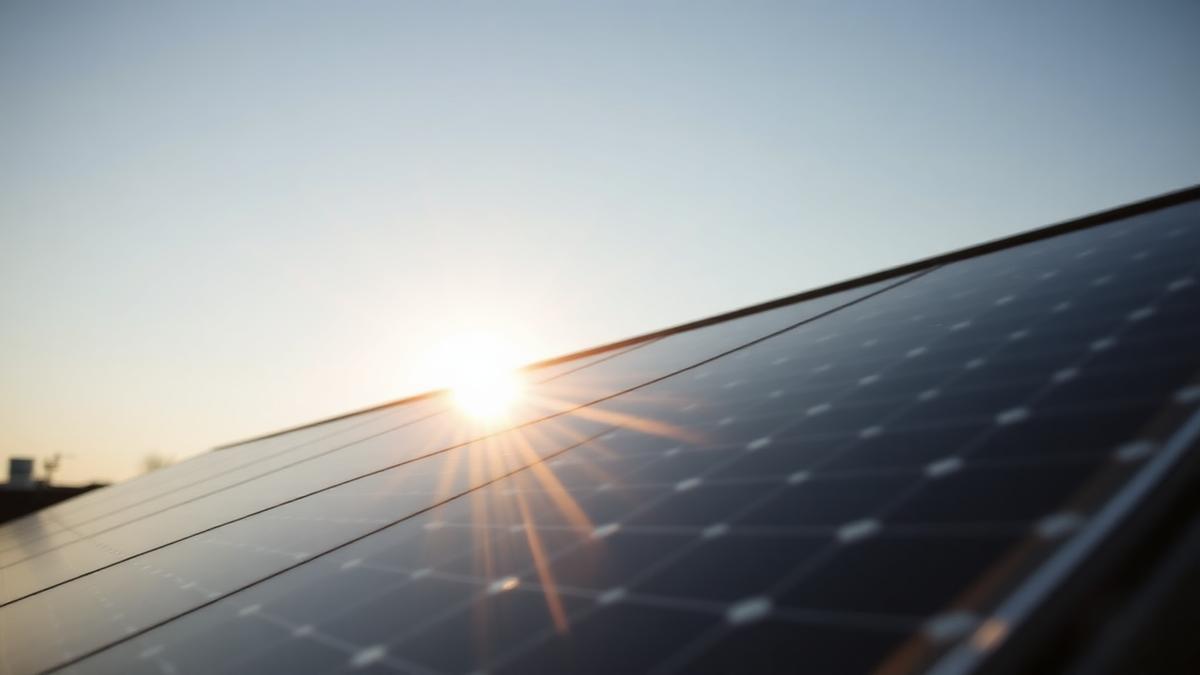
Solar panels look deceptively simple from the outside — flat, dark, motionless. Inside, they rely on a genuinely elegant piece of physics that converts particles of light directly into an electric current, without burning anything, boiling anything, or spinning any moving parts.
The material that makes it possible
At the heart of most solar panels is silicon, a material that is abundant, stable, and has a particular electronic structure that makes it well suited to this job. On its own, pure silicon is not especially useful for generating electricity. Manufacturers treat it with small amounts of other elements in a process called doping, creating two distinct layers with different electrical properties. One layer has a slight surplus of electrons; the other has a slight deficit, described as having "holes" where electrons could sit but do not.
Where these two layers meet, an internal electric field forms naturally, without any external power source. This built-in field is what makes the whole system work once light arrives.
Light arrives as packets of energy
Sunlight can be thought of as a stream of particles called photons, each carrying a certain amount of energy depending on its wavelength. When a photon with enough energy strikes the silicon, it can knock an electron loose from its position, leaving behind a hole and freeing the electron to move. Left alone, that freed electron would likely drift back and recombine with a hole nearby, releasing its energy as heat and accomplishing nothing useful.
The internal electric field at the junction between the two silicon layers prevents this. Instead of drifting randomly, the freed electron is pushed in a consistent direction by that field, and the hole is effectively pushed the other way. Multiply this by the vast number of photons striking a panel every second, and a steady, directional flow of electrons results — an electric current.
From current to usable power
Thin metal contacts on the surface and back of each cell collect this flow of electrons and route it out of the cell into a circuit, where it can do useful work. A single solar cell produces only a small amount of electricity, so panels combine many cells in series and parallel arrangements to reach a useful voltage and current for a household or commercial system.
Because most homes and the broader electricity grid use alternating current rather than the direct current a solar cell produces, an inverter is typically needed to convert the output into a form compatible with household appliances and the grid.
What affects how much electricity is produced
- Light intensity — more photons arriving means more electrons freed, up to the panel's capacity.
- Angle and orientation — panels facing more directly toward the sun capture more usable light.
- Temperature — somewhat counterintuitively, very hot panels can become slightly less efficient, since heat affects the electrical properties of the silicon.
- Shading — even a small shaded area can disproportionately reduce output, since cells are typically wired together in strings.
A summary of the process
| Step | What happens |
|---|---|
| 1 | Photons from sunlight strike the silicon layers |
| 2 | Electrons are knocked loose, creating free electrons and holes |
| 3 | The internal electric field pushes electrons and holes in opposite directions |
| 4 | Metal contacts collect the resulting flow as direct current |
| 5 | An inverter converts this into alternating current for use |
Why efficiency has limits
Not every photon that reaches a solar cell contributes to electricity. Some pass through without being absorbed, some carry more energy than needed and release the excess as heat, and some simply reflect off the surface. There are well-understood theoretical limits to how efficient a single-layer silicon cell can be, which is part of why researchers continue to explore alternative materials and multi-layer designs aimed at capturing a wider range of the light spectrum.
A century-old effect, still improving
The underlying photovoltaic effect has been understood for well over a hundred years, but turning it into an efficient, durable, and affordable technology took decades of material science refinement. What sits on a rooftop today is the product of that long refinement rather than a recent discovery — a steady, unglamorous piece of physics doing quiet, useful work in daylight. For more explanations of how everyday technology works, see our science coverage.
About the author
Idris Oyelaran covers consumer technology, privacy and applied science. He is happiest explaining a complicated system in ordinary language, and he tests every recommendation on his own devices before it appears in a story.